

Published in China News on 01.06.2026
China News: China Sets 2026 Growth Target at 4.5% to 5%
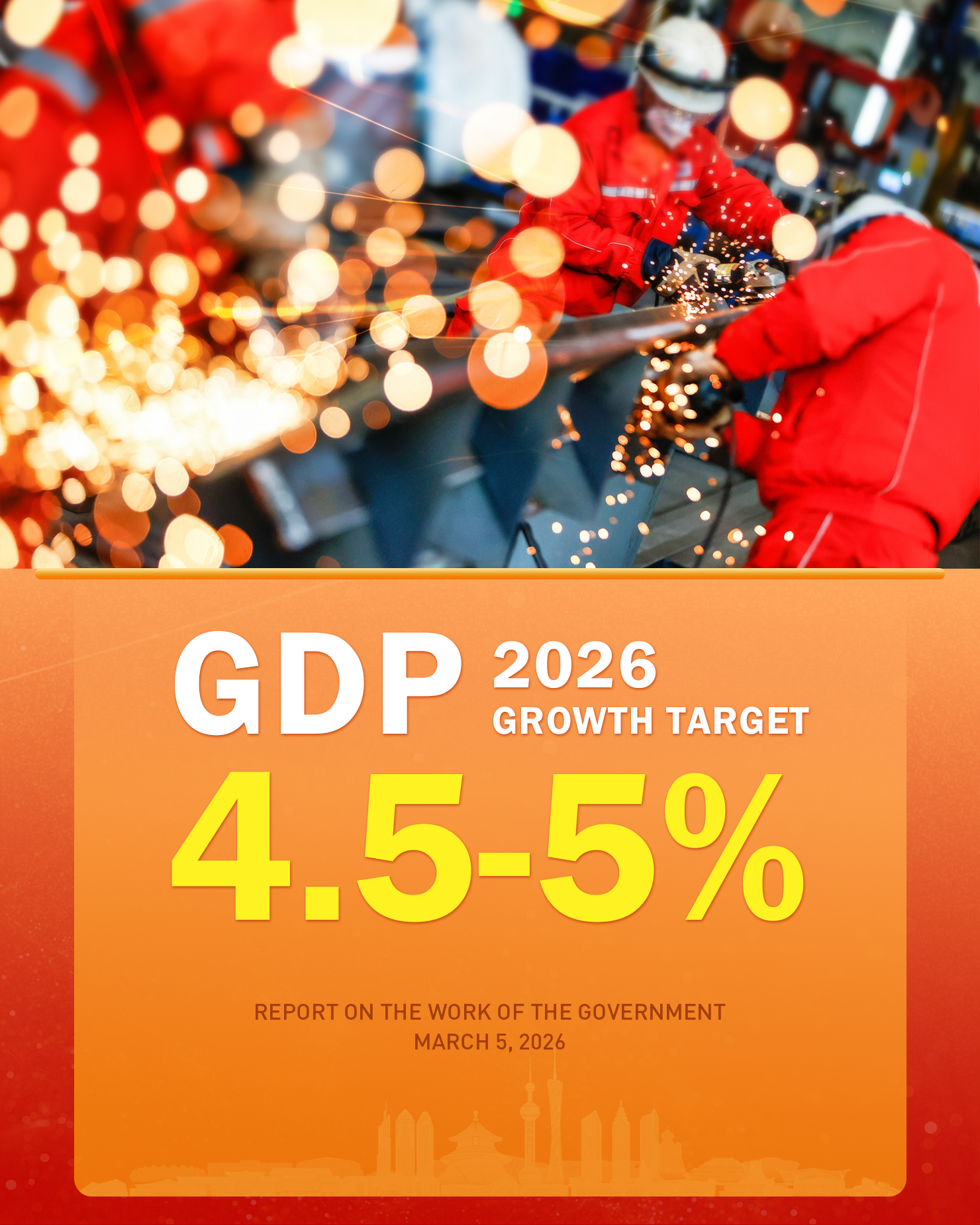
In a significant shift toward economic reorientation, China has set its official GDP growth target for 2026 at a range of 4.5% to 5%. The target, announced by Premier Li Qiang during the opening of the annual “Two Sessions” on March 5, 2026, signals Beijing’s shift away from rigid, rapid expansion in favour of high-quality development and economic resilience.
A Strategic Range Amid Global Uncertainty
For only the third time in its history, China has opted for a growth range rather than a fixed target. According to the 2026 Government Work Report, this flexibility serves the following purposes:
- To acknowledge external risks: Policymakers are preparing for ongoing trade tensions and uncertain global demand.
- To prioritize sustainability: The range gives local governments the necessary leeway to focus on efficiency rather than artificially inflating growth figures through excessive infrastructure spending.
- To secure the lower limit: While the upper limit of 5% reflects ambition, the lower limit of 4.5% provides a realistic baseline that the government is determined to defend.
Expansionary Fiscal Policy and Accommodative Monetary Policy
To achieve these goals, Beijing is pursuing the most expansionary fiscal policy in years. The official budget deficit is set at 4% of GDP, with the absolute deficit rising to 5.89 trillion RMB.
However, when other instruments such as ultra-long-term government bonds and special bonds issued by local governments are taken into account, the effective fiscal stimulus reaches nearly 12 trillion RMB. It is noteworthy that the spending structure is shifting: away from traditional “concrete infrastructure” and toward “investments in people.” Funds are increasingly flowing into healthcare, education, and social security systems to stimulate private consumption.
On the monetary front, the central bank has adopted a rare “appropriately accommodative” stance. This points to further interest rate cuts and a reduction in reserve requirement ratios, as the government aims for an inflation target of around 2% to counter deflationary trends.
Key Economic Goals for 2026
The report outlines additional critical targets for stabilising the domestic economy:
- Income & Employment: Household income is expected to grow in line with GDP to strengthen domestic demand.
- Food security: Grain production is estimated at 1.4 trillion jin (approx. 700 million tons) to ensure self-sufficiency during times of geopolitical instability.
- Green transition: The government aims to reduce CO₂ emissions per unit of GDP by approximately 3.8% this year.
Implications for International Companies
It stands to reason that the benefits of a stable macroeconomic environment will be unevenly distributed.
Foreign investors do see a “steady and orderly” opening of the services sector—particularly in telecommunications, biotechnology, and healthcare. However, it appears that the biggest hurdles for foreign firms currently lie less in China’s domestic policy and more in geopolitical tensions and the reconfiguration of global supply chains.
“The policy orientation remains ‘quality growth,’ not ‘growth at any cost.’ Companies should not expect massive infrastructure programs or aggressive credit expansion just to boost GDP.”
For companies operating in China, the outlook for 2026 underscores a clear transition: the era of boundless growth is over. It is being replaced by a strategic focus on technological innovation, green energy, and the “silver economy” for the aging population.